
Definition and general operation
Components of an ATG system
Thermogravimetric analysis (TGA) is a thermal analysis technique used to measure the mass change of a sample as a function of temperature or time. This method is used to study physical and chemical processes such as dehydration, thermal decomposition, oxidation, and volatilization. It also has valuable applications in the cosmetics industry , particularly for ensuring the thermal stability and efficacy of formulations by analyzing excipients and active ingredients. By heating a material under a controlled atmosphere, TGA identifies mass changes, revealing key information about the thermal stability and composition of the materials.
An ATG system consists of several essential elements that ensure the accuracy and reliability of the analyses:
- The microbalance : It measures mass variations with extreme precision, often on the microgram scale. It is protected by an inert atmosphere to prevent interference from unwanted chemical reactions.
- The oven : It allows the temperature of the sample to be controlled according to a predefined program. This component is capable of heating, cooling, and maintaining a constant temperature.
- The gas management system : It regulates the atmosphere around the sample. Depending on the needs, an inert atmosphere (nitrogen, argon) or a reactive atmosphere (oxygen, air) can be generated to simulate specific experimental conditions.
- The control software : It records data, controls experimental parameters and allows for in-depth analysis of results.
Importance of measurement accuracy
The accuracy of the three fundamental parameters – mass, temperature, and time – is crucial to ensuring usable results. The measured mass variations are often very small and require rigorous calibration of the microbalance. Furthermore, temperature variations must be controlled with high accuracy to avoid any misinterpretation of the data.
Complementarity between thermogravimetric analysis and calorific value analysis
Thermogravimetric analysis (TGA) and calorific value analysis (HHV and LHV) are effectively complementary in the laboratory for characterizing the thermal properties of materials. While TGA focuses on mass changes related to processes such as decomposition, dehydration, or oxidation, calorific value analysis quantifies the energy released during combustion or thermal degradation of samples. Together, these techniques provide a detailed view of the thermal interactions of materials: TGA identifies transformation steps, while calorific value quantifies the energy associated with these transformations. This complementarity is particularly useful in sectors such as energy, where a thorough understanding of the thermal characteristics of solid fuels, biomass, or polymers is essential for optimizing their performance and sustainability.
2. Scientific and industrial applications of thermogravimetric analysis
Materials research
TGA plays a crucial role in research on the properties of materials, whether polymers, composites, or metals. Here are a few examples:
- Thermal characterization : TGA allows the identification of decomposition, phase transition, or melting temperatures of materials. This data is essential for understanding the thermal stability of materials.
- Residual analysis : Measuring ash or filler content in a sample provides valuable information about its chemical composition.
- Chemical kinetics studies : Mass changes as a function of time and temperature are used to model chemical reactions, such as oxidation or reduction.
Applications in the chemical industry
In the chemical industry, TGA is used to ensure product quality and efficacy. Some examples of specific applications include:
- Additive evaluation : TGA is used to measure the quantity and thermal stability of additives present in formulations.
- Control of residual solvents : TGA allows the detection of solvent residues in finished products, ensuring their compliance with safety standards.
Plastics industry sector
ATG is an indispensable tool for plastics and polymer manufacturers. It is used for:
- Analyze thermal decomposition : Identify critical temperatures to avoid material degradation during processing.
- Optimizing formulations : By measuring mass losses due to evaporation or decomposition, TGA helps to adjust formulations for optimal performance.
Coatings and paints industry
Paint and coating manufacturers use ATG to evaluate:
- Resin and pigment content : Analysis allows verification of the quality of the formulations.
- Thermal stability : The data obtained allows us to assess the durability of the coatings in extreme thermal environments.
Environmental applications
TGA is also a valuable tool for environmental analyses, such as:
- The study of gas emissions : By coupling TGA with techniques such as mass spectrometry (TGA-MS), it is possible to analyze the gases emitted during the thermal decomposition of materials.
- Waste analysis : This allows us to determine the composition of solid waste, thus facilitating its treatment or recycling.
Advantages of thermogravimetric analysis
- Versatility : Adaptable to a wide range of materials and experimental conditions.
- Accuracy : High sensitivity in detecting mass variations.
- Speed : Enables real-time analysis, reducing delays in research and development processes.
Are you looking for an analysis?
3. Instruments and technologies of thermogravimetric analysis
The essential components of a thermogravimetric analyzer
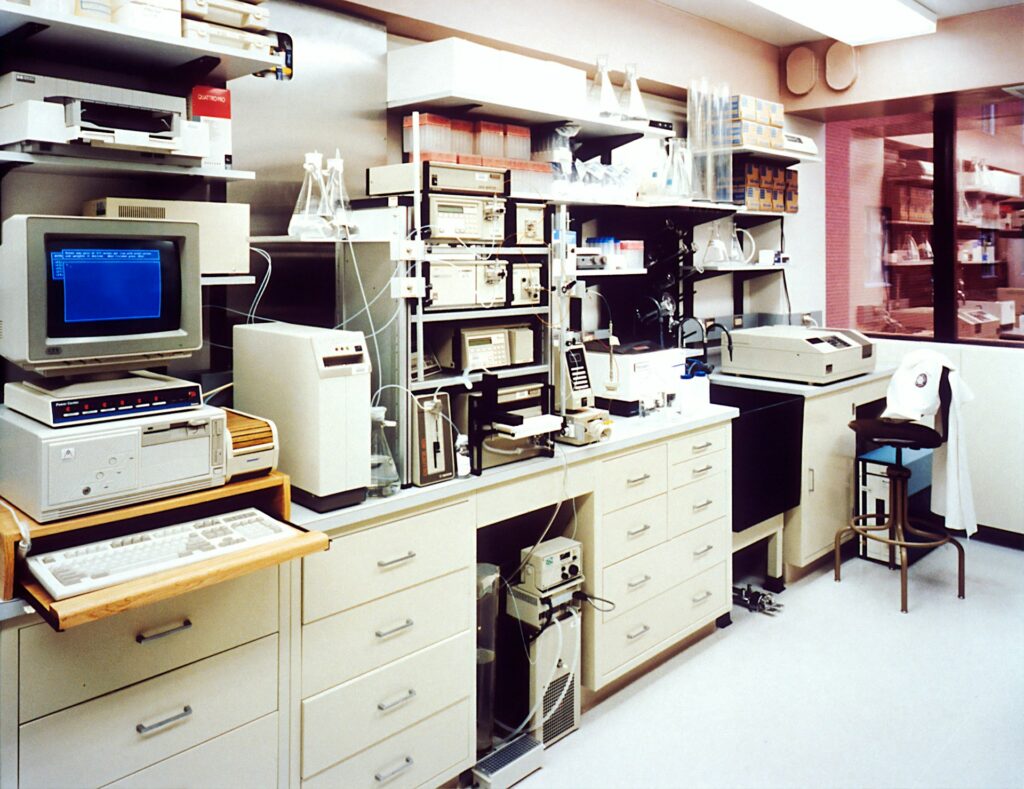
A thermogravimetric analyzer, also called a thermobalance, is composed of several key elements that work together to provide high-precision data:
- The furnace : This is the central element where the analysis takes place. It is capable of heating the sample according to a programmed temperature profile, generally in a range from ambient temperature to over 1000 °C.
- The microbalance : It measures mass variations with extreme precision, often down to the microgram level. This makes it possible to detect mass losses due to phenomena such as volatilization or decomposition.
- The gas control system : This system regulates the atmosphere around the sample. The gases used can be inert (nitrogen, argon) or reactive (oxygen, carbon dioxide), depending on the needs of the analysis.
- Analysis software : All the collected data is processed by software that generates thermogravimetric curves and their derivatives, thus facilitating interpretation.
Advanced technologies for more comprehensive analysis
Modern equipment offers additional features that enhance the capabilities of thermogravimetric analysis:
- Coupling with other techniques : The analyzers can be coupled to mass spectrometers (TGA-MS) or infrared spectrometers (TGA-FTIR). These techniques allow for the characterization of gases emitted during sample decomposition.
- Simultaneous thermal analysis (STA) : Some devices incorporate differential scanning calorimetry (DSC) measurements in addition to mass variations, thus enabling the identification of thermal transitions such as melting or crystallization.
- Specific test environments : Some models allow testing under complex atmospheres, such as environments rich in water vapor or corrosive gases, to simulate real-world operating conditions.
The importance of supports and accessories
The crucibles used to hold the samples also play a crucial role. They must be suitable for the analysis to avoid interference:
- Crucible materials : Crucibles can be made of alumina, platinum or quartz, each material having specific thermal and chemical resistance properties.
- Shape and size : The shape and volume of crucibles influence the circulation of gases around the sample and, consequently, the accuracy of measurements.
Calibration and maintenance of devices
To ensure reliable results, TGA devices must be regularly calibrated and maintained:
- Microbalance calibration : Regular calibration is essential to maintain the accuracy of mass measurement.
- Temperature system check : Thermocouples must be checked to ensure they are measuring temperature correctly.
- Gas system maintenance : Pipes and valves must be cleaned and inspected to prevent contamination or blockages.

4. Practical applications of thermogravimetric analysis
Materials characterization
Thermogravimetric analysis is commonly used to study the properties of materials and their behavior under different conditions:
- Thermal stability : TGA allows us to determine the temperatures at which materials begin to decompose, which is crucial for assessing their durability in high-temperature environments.
- Material composition : This technique identifies the proportion of organic, inorganic, and volatile compounds present in a material, providing essential information for its optimization.
- Ash and filler content : It helps to quantify the solid residues after combustion, which is important for analyzing composite and polymer formulations.
Study of thermal transitions
Thermogravimetric analysis detects physical and chemical transitions in materials, such as:
- Desorption and dehydration : Mass losses due to evaporation of water or other solvents are identified, providing data on the water stability of the samples.
- Decomposition and combustion : The characteristic temperatures of these phenomena are measured, helping to predict the behavior of materials in reactive environments.
Research and development
In research laboratories, TGA is an essential technique for:
- Designing new materials : It helps to understand the mechanisms of thermal degradation, facilitating the development of more resistant materials.
- Optimizing formulations : The data obtained allows the proportions of components to be adjusted to achieve desired properties.
- Studying gas-solid interactions : TGA is used to analyze specific reactions, such as oxidations, which influence the reactivity of materials.
Industrial applications
In an industrial setting, thermogravimetric analysis is used in various sectors:
- Polymer industry : It evaluates the thermal stability of plastics and elastomers, allowing for the optimization of their mechanical and thermal properties.
- Pharmaceutical and cosmetic : TGA is used to analyze excipients and active ingredients, ensuring the stability and efficacy of formulations.
- Energy and environment : It plays a key role in the development of materials for batteries and in the study of gas emissions during combustion.
Environmental analysis
TGA is also valuable for environmental studies:
- Waste analysis : It identifies volatile compounds and residues in solid waste, helping to improve recycling processes.
- Soil study : Mass losses due to the volatilization of organic compounds in soils are quantified, providing insights into soil composition and contamination.
5. Analytical couplings with thermogravimetric analysis
Principle of analytical couplings
Analytical coupling involves combining thermogravimetric analysis (TGA) with other analytical techniques to enhance the understanding of material properties and reactions. This method allows for the collection of additional data, often essential for an accurate interpretation of observed phenomena.
The most commonly used couplings with TGA include:
- TGA-MS (mass spectrometry) : Analysis of gases emitted during thermal transformations to identify their composition.
- TGA- FTIR (Fourier transform infrared spectroscopy) : Study of the chemical structures of the released gaseous compounds.
- TGA-GC (gas chromatography) : Separation and identification of volatile components.
ATG-MS: an in-depth look at gaseous emissions
Combining TGA with mass spectrometry allows for the identification of gases emitted during thermal reactions. This coupling is particularly useful for:
- Analyze the decomposition products : Identify the specific molecules released during thermal degradation.
- Studying pollutant emissions : Measuring harmful gases, such as sulfur or nitrogen oxides, resulting from the combustion of materials.
- Understanding reaction kinetics : Determining the stages and rates of chemical transformations.
TGA-FTIR: detection of chemical structures
Infrared spectroscopy coupled with TGA provides information on the chemical structure of emitted gases. This coupling is particularly suitable for:
- Identify volatile organic compounds (VOCs) : Detect substances such as formaldehyde or aromatic hydrocarbons.
- Analyze molecular interactions : Observe the changes in functional groups during thermal reactions.
- Studying the properties of complex materials : Understanding the phenomena of adsorption or desorption in porous solids.
ATG-GC: Component separation and identification
Coupling with gas chromatography allows for the separation of volatile components prior to their identification. This coupling is essential for:
- Analyze complex mixtures : Identify each component of a gaseous mixture with high precision.
- Studying volatilization kinetics : Measuring the release rate of gases for environmental or industrial applications.
- Detecting residual solvents : Identifying traces of solvents in materials such as polymers or pharmaceuticals.
Advantages of analytical coupling
Couplings with ATG offer several advantages:
- Multidimensional approach : Provides a comprehensive view of the thermal, chemical, and structural properties of the samples.
- High precision : Allows detection of compounds even at very low concentrations.
- Flexibility : Adapt the analysis to a wide variety of materials and applications.
6. Applications of thermogravimetric analysis
Research and development of new materials
Thermogravimetric analysis is essential in the field of materials for:
- Developing advanced polymers : Identifying decomposition temperatures, phase transitions, and residues to optimize formulations.
- Characterizing composites : Understanding the interactions between organic and inorganic components in hybrid materials.
- Evaluate thermal resistance : Study the stability of materials under extreme temperature and atmospheric conditions.
For example, in the automotive industry, ATG is used to develop heat-resistant polymers for engine parts.
Quality control and regulatory compliance
In industrial environments, TGA is an essential quality control tool for:
- Check the purity of materials : Detect impurities or contaminants.
- Evaluate additives : Measure the quantities of reinforcing agents or plasticizers.
- Ensuring compliance with standards : Meeting regulatory requirements on emissions and material composition.
In the pharmaceutical industry, TGA helps to identify residual solvents in formulations, ensuring their safety for consumers.
Environmental studies and sustainability
ATG plays a key role in environmental research, particularly in:
- Analyze emissions : Study the gases emitted by decomposing materials to identify pollutants.
- Characterizing biomass : Determining the levels of volatile matter, fixed carbon and ash to optimize energy conversion.
- Assess the recyclability of materials : Identify recoverable or reusable compounds.
Research on alternative fuels, such as wood pellets, uses TGA to assess their energy potential.
Optimization of industrial processes
In the manufacturing industry, TGA is used to improve production processes:
- Process temperature control : Identify the ideal temperature ranges for heat treatments or chemical reactions.
- Cost reduction : Optimize material use by identifying potential losses through volatilization or degradation.
- Improving product performance : Studying thermal stability to extend the lifespan of finished products.
The paint and coatings industries, for example, use ATG to ensure that their formulations withstand heat and extreme weather conditions.
Basic research
In research laboratories, ATG is a valuable tool for:
- Studying reaction mechanisms : Understanding the chemical and physical interactions of materials.
- Characterize thermal transformations : Identify the transient phases and the final products.
- Exploring new scientific fields : Developing innovative materials for emerging technologies such as batteries or semiconductors.