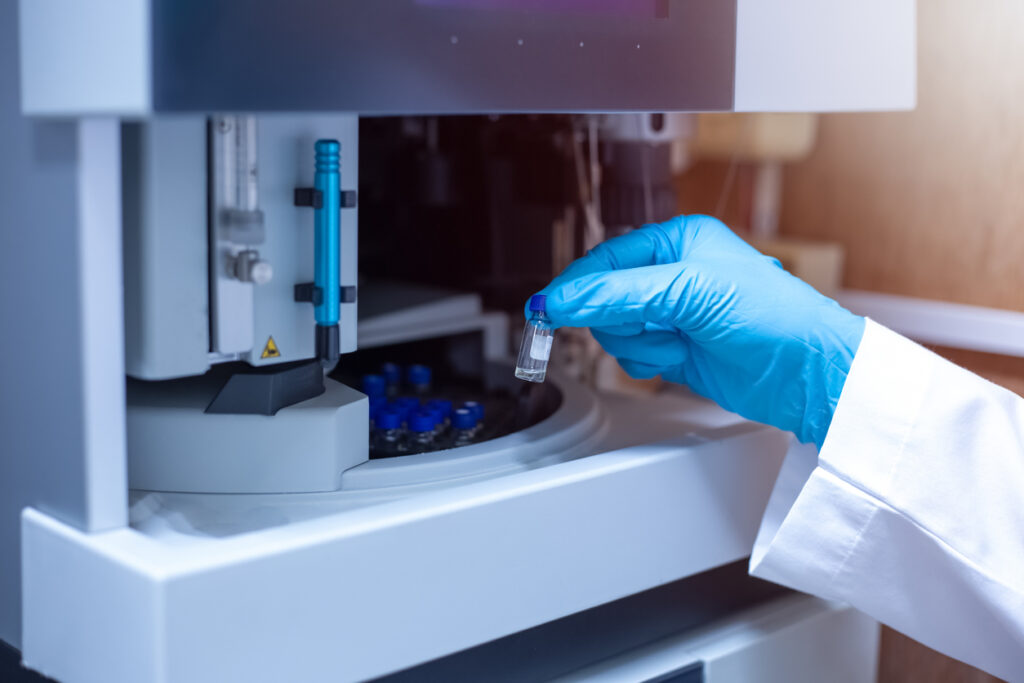
High-performance liquid chromatography (HPLC) is an essential method for modern laboratory analysis. Used in various sectors such as pharmaceuticals, food and beverage , and cosmetics , it allows for the separation, identification, and quantification of the components of a mixture with remarkable precision. In this section, we will explore the fundamental principles of this technique, highlighting its scientific basis and practical applications.
1. What is the principle of HPLC?
Definition and operation of HPLC
HPLC is an advanced analytical technique that relies on separating the compounds in a mixture based on their physicochemical properties. It uses two distinct phases:
- Mobile phase : a liquid (often a mixture of solvents) that transports the sample through the system.
- Stationary phase : a solid surface contained within a chromatographic column, on which compounds interact differently depending on their characteristics.
The sample is injected into the system and propelled by the mobile phase through the column. Interactions between the analytes, the mobile phase, and the stationary phase determine the rate at which each compound passes through the column. These differences in retention time allow the components to be separated for individual analysis.
Difference between liquid chromatography and HPLC
The main difference between conventional liquid chromatography (LC) and high-pressure liquid chromatography (HPLC) lies in the improved performance achieved through high pressure. While LC operates at atmospheric pressure, HPLC uses a powerful pump to maintain a continuous flow through very small stationary particles (2 to 5 micrometers).
These particles increase the interaction surface area between the analytes and the stationary phase, thus improving the resolution and sensitivity of the analysis. This allows the detection of compounds at very low concentrations, which is essential in fields such as pharmaceuticals.
The science behind the separation of compounds
Separation in HPLC relies on complex physicochemical phenomena. Three main types of interactions influence the process:
- Polarity : Polar analytes have an affinity for polar stationary phases (normal phase chromatography), while nonpolar compounds are better retained on nonpolar stationary phases (reverse phase chromatography).
- Van der Waals forces : These forces play a key role in the molecular interactions between analytes and stationary phase particles.
- Solubility : The solubility of compounds in the mobile phase affects their ability to be transported through the system.
By modifying the properties of the mobile phase (for example, by adjusting the pH or adding an organic solvent), laboratories can optimize the separation of compounds. This flexibility is one of the major advantages of HPLC, allowing it to be adapted to complex sample matrices, ranging from pharmaceuticals to food products.
Key figures on HPLC performance
HPLC offers unparalleled performance in terms of accuracy and sensitivity. Here are some key figures:
- Particle size : Generally between 2 and 5 micrometers, it directly influences the resolution of chromatographic peaks.
- Pump pressure : It can reach up to 40 MPa, compared to atmospheric pressure in conventional LC.
- Retention time : Varies from a few seconds to several minutes, depending on the nature of the analyte and the operating parameters.
- Detection limit : Often on the order of nanograms, it allows the detection of minute traces of compounds in complex matrices.
These characteristics make HPLC a reference method for laboratory analyses, guaranteeing reliable and reproducible results in short timeframes.
2. How to perform an HPLC analysis
Key steps in HPLC analysis
Performing an HPLC analysis follows a structured process, comprising several essential steps:
- Sample preparation :
- The sample is often diluted or filtered to remove impurities that could damage the column or interfere with the results.
- The sample concentration is adjusted to be within the linear detection range of the instrument.
- Selection of stationary and moving phases :
- The stationary phase is chosen according to the properties of the analytes (polarity, molecular size, etc.). For example, a reversed-phase (C18) column is often used for nonpolar compounds.
- The mobile phase is selected to optimize separation. It may include mixtures of solvents such as water, acetonitrile or methanol, often adjusted with buffers to control the pH.
- Sample injection :
- A small amount of sample (usually between 5 and 100 µL) is injected into the system. This step is often automated using an automatic injector to ensure repeatability.
- Separation in the chromatographic column :
- The sample passes through the column under the influence of the mobile phase. The compounds interact with the stationary phase, causing their separation according to their physicochemical properties.
- Detection and recording of results :
- Analytes are detected based on their specific characteristics (UV absorption, fluorescence, etc.).
- The data is recorded in the form of a chromatogram, where each peak corresponds to a compound.
Equipment and instrumentation
An HPLC analysis relies on advanced instrumentation composed of the following elements:
The pump :
It ensures a constant flow rate of the mobile phase, essential for maintaining stable pressure in the system. Modern pumps can handle isocratic (fixed composition) or gradient (variable composition) elutions.
The injector :
Allows the sample to be introduced into the mobile phase flow. Automated systems ensure precise and repeatable injection.
The chromatographic column :
At the heart of the system, it contains the stationary phase. The columns are available in different sizes and compositions to meet the specific needs of each analysis.
The detector :
Several types of detectors can be used depending on the nature of the analytes:
- UV-Vis : Measures the absorption of light by compounds.
- Refractive index (RI) : Ideal for chromophore-free analytes.
- Light scattering by evaporation (ELSD) : Detects semi-volatile or non-volatile compounds.
The analysis software :
Modern systems incorporate tools to control instrumentation, analyze data, and produce detailed reports.
Optimization of the HPLC method
Optimizing an HPLC method is essential for obtaining accurate and reliable results. Several parameters can be adjusted:
Mobile phase throughput : Too fast a throughput can reduce resolution, while too slow a throughput increases analysis time.
Mobile phase composition : The choice of solvents and their proportions directly influence analyte retention. For example, increasing the proportion of acetonitrile can reduce the retention times of nonpolar compounds.
Column temperature : Temperature influences the viscosity of the mobile phase and the interactions between the analyte and the stationary phase. Heated columns improve the reproducibility of results.
Elution method :
- Isocratic : Suitable for simple mixtures.
- Gradient : More suitable for complex mixtures, with optimized separation of analytes of varying polarities.
Factors influencing the results of an HPLC analysis
The success of an HPLC analysis depends on many factors, including:
- Solvent purity : Impurities can interfere with results and damage the instrument.
- Sample preparation : Inadequate preparation can lead to blockages in the column or spurious peaks in the chromatogram.
- Calibration : The use of internal or external standards is essential to ensure the accuracy of quantitative results.
By mastering these aspects, laboratories can maximize the accuracy and reproducibility of analyses, thus meeting the demanding needs of various industrial sectors.
3. Why is HPLC more commonly used in the pharmaceutical industry for quantitative analyses?
Sensitivity and precision tailored to pharmaceutical needs
In the pharmaceutical industry, the need to guarantee the safety, efficacy, and quality of medications requires extremely precise analytical techniques. HPLC is distinguished by:
- Its increased sensitivity : It allows the detection and quantification of compounds in very low concentrations, often at the nanogram or picogram scale.
- Its exceptional precision : It offers reproducible results, even for complex samples or matrices containing impurities.
These characteristics are particularly useful for accurately measuring the quantities of active ingredients in formulations, an essential step to ensure compliance with international pharmaceutical standards.
Regulatory compliance and strict standards
HPLC is widely used in the pharmaceutical industry because it meets the requirements of strict regulations imposed by authorities, including:
- ISO 17025 standards : These standards guarantee the competence of laboratories performing analytical tests.
- Good manufacturing practices (GMP) : Mandatory in the pharmaceutical industry, they require the use of validated methods, such as HPLC, to ensure product quality.
- International Pharmacopoeias : HPLC is often cited as the reference method for analyzing active substances and excipients in European (Ph. Eur.), American (USP), and Japanese (JP) pharmacopoeias.
Thanks to its ability to produce reliable and traceable results, HPLC is establishing itself as the method of choice for pharmaceutical laboratories seeking to meet these requirements.
Specific applications of HPLC in pharmacy
HPLC is used at every stage of a drug's lifecycle, from research and development to quality control in production. Here are some of its key applications:
- Dosage of active ingredients (API) :
- HPLC is used to determine the concentration of active pharmaceutical ingredients in a formulation, ensuring that the product delivers the correct dose to the patient.
- For example, it can measure the paracetamol content in a tablet or the ibuprofen content in a topical gel.
- Impurity detection :
- The presence of impurities, even in very small quantities, can affect the safety and efficacy of medications. HPLC allows for the detection and quantification of these impurities, including nitrosamines, which are recently regulated.
- Formulation validation :
- When developing new formulations, HPLC is used to verify the chemical stability of active substances and their compatibility with excipients.
- Analysis of finished products :
- Before marketing, each batch of medicine is subjected to quality control tests by HPLC to ensure that it meets established specifications.
Comparison with other analytical techniques
HPLC is often compared to other analytical methods, but it proves superior in many cases for pharmaceutical applications:
- UV-Vis spectrophotometry : Although rapid, this method lacks specificity for differentiating compounds with similar absorption spectra. HPLC, on the other hand, physically separates compounds before detection.
- Gas chromatography (GC) : This technique is effective for volatile compounds, but unsuitable for thermosensitive or non-volatile analytes, which represent a large part of pharmaceutical substances.
- Mass spectrometry alone : Mass spectrometry is often coupled with HPLC to further improve accuracy and specificity in demanding applications.
Figures and illustrative examples
Statistics demonstrate the importance of HPLC in the pharmaceutical industry:
- 90% of pharmaceutical quality control tests include HPLC as a primary or complementary method.
- A study by the World Health Organization revealed that HPLC is used in more than 75% of global pharmaceutical laboratories .
- Impurities such as nitrosamines, detected at concentrations below 0.03 ppm using HPLC, have led to major drug recalls, highlighting the importance of this technology.
In conclusion, HPLC has become an indispensable analytical tool in the pharmaceutical industry. Its sensitivity, accuracy, and compliance with standards make it the preferred method for ensuring the safety and quality of medications intended for patients.
Are you looking for an analysis?
4. What is the purpose of chromatography?
Understanding the fundamental objectives of chromatography
Chromatography, and more specifically HPLC, has the primary purpose of separating, identifying, and quantifying compounds present in a complex mixture. This capability relies on the differential interactions of analytes with two distinct phases: a mobile phase and a stationary phase. The main objectives include:
- Separation of complex mixtures : Identifying the individual components of a sample containing multiple substances.
- Compound identification : Associate each chromatographic peak with a specific compound.
- Precise quantification : Measure the exact concentration of each analyte for reliable qualitative and quantitative analyses.
These functions make chromatography essential in fields as varied as pharmaceutical analysis, environmental research, and food quality control.
Practical applications in different sectors
Chromatography is used in a multitude of industries, each with specific needs. Here are a few examples:
Pharmaceutical industry :
- Identify the active substances and excipients.
- Detecting impurities to ensure drug safety.
- Detect contaminants, such as mycotoxins or pesticides .
- Analyze the nutritional components, such as amino acids and vitamins.
Cosmetics industry :
- Monitor levels of parabens or heavy metals.
- Analyze the assets to ensure their compliance with marketing claims.
- Measuring pollutants in soil, water and air.
- Monitor regulated substances, such as polycyclic aromatic hydrocarbons (PAHs).
The advantages of chromatography compared to other methods
Chromatography, particularly HPLC, offers significant advantages over other analytical techniques:
- Application flexibility : It allows for the analysis of volatile, semi-volatile and non-volatile compounds.
- Precision and sensitivity : It can detect minute traces of compounds, often down to nanogram levels.
- Reproducibility of results : Standardized parameters ensure reliable analyses, repeated on similar samples.
Limitations and challenges of chromatography
Despite its many advantages, chromatography has certain limitations:
- Solvent compatibility : Incompatible solvents can damage equipment or reduce separation efficiency.
- High cost : Chromatographic equipment and specific columns can represent a significant investment.
- Analysis time : Although fast for simple samples, chromatography can become lengthy for complex mixtures requiring extensive optimization.
The scientific basis of the separation process
Separation in chromatography is based on two fundamental scientific principles:
- Sharing of analytes between phases :
- The analytes are separated according to their relative affinity for the mobile phase and the stationary phase.
- For example, in reversed-phase chromatography, hydrophobic compounds are retained longer, while hydrophilic compounds elute more quickly.
- Kinetics of the processes :
- The diffusion of molecules between phases directly influences the resolution of chromatographic peaks.
- A well-optimized column, with small particles, improves efficiency by reducing the diffusion phenomenon.
5. Scientific application: laboratory analysis with HPLC
Case study: Malic acid analysis
The analysis of malic acid perfectly illustrates the effectiveness of HPLC for measuring the concentration of a specific compound in complex matrices.
Use of HPLC for malic acid :
- In the food industry, HPLC allows for the quantification of malic acid in products such as fruit juices, wines, and jams. This analysis ensures that the levels comply with regulatory standards.
- In the cosmetics industry, HPLC measures malic acid to assess its concentration as an alpha-hydroxy acid (AHA), often used for its exfoliating properties.
Analysis procedure :
- The sample is prepared by diluting it in a buffered solution and filtered to remove unwanted particles.
- A reversed-phase column (C18) is used, with a mobile phase composed of a mixture of water and acetonitrile adjusted to the optimal pH for efficient separation.
- The UV-Vis detector is set to a specific wavelength (usually around 210 nm) to detect and quantify malic acid.
Results and interpretation :
- The chromatogram obtained shows a distinct peak corresponding to malic acid, allowing for precise quantification based on a calibration curve.
Importance of Regulatory Compliance
HPLC plays a crucial role in complying with the strict regulatory standards that govern product analysis in many sectors.
ISO 17025 standards and COFRAC accreditation :
- These standards ensure that laboratories perform analyses according to validated protocols and that the results are reliable and traceable.
- For example, for food products, HPLC analysis makes it possible to comply with the regulatory thresholds defined by the European Union for organic acids, such as malic acid.
Migration tests in packaging :
- HPLC is also used to ensure that packaging materials in contact with food comply with EC Regulation No. 1935/2004.
- It allows us to quantify substances that can migrate from packaging into food, thus ensuring consumer safety.
Advanced applications and additional testing
HPLC is often combined with other analytical techniques for even more in-depth analyses.
Coupling with mass spectrometry (LC-MS) :
- This coupling improves the specificity and sensitivity of the analysis, making it possible to detect minute traces of contaminants or impurities.
- For example, LC-MS is used to identify pesticide residues in fruits and vegetables or complex impurities in medicines.
Rheological tests for food products :
- HPLC is used to analyze additives, such as malic acid, that influence the texture and stability of food formulations.
- Rheological tests measure the fluidity and consistency of products, ensuring optimal quality for the consumer.
Application figures and data
- 98% of ISO 17025 certified laboratories include HPLC in their standard analytical methods.
- Migration tests performed by HPLC account for more than 60% of food packaging analyses in the European Union.
- In cosmetics, HPLC allows verification of the concentration of organic acids in 80% of skincare formulations containing AHAs .
In conclusion, the scientific application of HPLC extends far beyond simple analysis. It offers unparalleled flexibility and precision, suitable for diverse sectors and increasingly complex needs. Its role in regulatory compliance and technological innovation makes it an indispensable tool for modern laboratories.