In 2026, managing or equipping a laboratory involves an increasingly delicate balance. Budgetary pressure is intensifying, regulatory and accreditation requirements are becoming stricter, analysis times are shortening, and environmental issues — CSR, waste reduction, resource efficiency — are now at the heart of purchasing and organizational decisions.
In this context, the model of the laboratory which performs all its analyses in-house and buys all of its equipment new clearly shows its limitations.
Three strategic levers now make it possible to optimize a laboratory without sacrificing either the quality of results or regulatory compliance: targeted outsourcing of analyses, the circular economy applied to equipment, and resource sharing. This practical guide details, for technical and purchasing managers, how to concretely activate each of these levers. What decision criteria should be applied? And above all, how to combine them in a truly effective hybrid approach?
Table of Contents
Why has optimizing one's laboratory become a necessity?
Before going into detail about the levers, it is useful to understand what is fundamentally changing in the daily operations of laboratories.
First, the cost of analytical equipment continues to rise. A chromatograph, mass spectrometer, or automated analysis system represents an investment of tens of thousands of euros, to which must be added maintenance, consumables, calibration, and staff training. Amortizing such equipment requires a sufficient volume of analyses—which is not always the case, particularly for specialized or occasional analyses.
Next, compliance requirements become more stringent. ISO 17025 accreditation, COFRAC certifications, data traceability, and equipment qualification (IQ/OQ/PQ) require significant resources. Maintaining in-house accreditation across a broad scope is costly in terms of both time and money.
Finally, the environmental dimension is no longer optional. The scientific sector generates a considerable amount of waste, whether it be equipment discarded while still functional, electronic waste, or unused consumables. Corporate and institutional CSR policies now require consideration of the carbon footprint of purchases and the lifespan of equipment.
Optimizing your laboratory is therefore not just about reducing costs. It's about intelligently rethinking what you internalize, what you outsource, what you buy new and what you reuse.
Lever 1: Intelligently outsource your analyses
Systematically internalizing all analyses is rarely the most rational choice. Some analyses are one-off, others require expensive equipment that is amortized over too few samples, and still others demand highly specific accreditation or expertise that is difficult to maintain in-house. In these cases, outsourcing is often the most relevant decision, both technically and financially.
Which analyses should be outsourced as a priority?
Here are some concrete criteria for deciding, analysis by analysis, between in-house production and outsourcing:
- Non-routine or complex analyses. Rare assays or specialized methods (LC-MS/MS, GC-MS, NMR, etc.) that you only perform a few times a year do not justify the investment in equipment, the associated skills development, or the effort required to maintain accreditation. Outsourcing is almost always the better option in these cases.
- Peak loads. When a one-off influx of samples saturates your internal capacity, outsourcing the surplus allows you to absorb the demand without permanently oversizing your teams and machines for temporary needs.
- Analyses requiring specific accreditation. Using a laboratory already accredited (ISO 17025, COFRAC) within a given scope saves you considerable time and immediately secures the regulatory value of your results, without having to build the accreditation yourself.
- Analyses requiring very expensive equipment. Before purchasing an instrument costing tens of thousands of euros, calculate the actual cost per sample, including depreciation, maintenance, and consumables. Below a certain volume, outsourcing remains significantly more advantageous.
- Analysis of unusual matrices. A complex or rare matrix may require sample preparation or a method that only a specialized laboratory can master. Rather than experimenting in-house, access to proven expertise ensures reliable results.
How to calculate the internal/external break-even point?
The decision to outsource or in-house an analysis is based on a simple calculation, even if it requires gathering some data. For in-house analysis, add up the equipment acquisition cost (amortized over its lifespan), annual maintenance, consumables per analysis, technician time, and the cost of maintaining accreditation. Divide this total by the number of analyses performed per year: this gives you an internal cost per sample. Compare this to the outsourcing rate. Below a certain annual volume, the internal cost per sample skyrockets because the fixed costs (equipment, accreditation) are spread over too few analyses. This is precisely where outsourcing makes perfect sense.
The benefits of well-managed outsourcing
Outsourcing isn't about losing control; it's about gaining flexibility. You gain access to a range of equipment and a network of expertise without tying up capital. You transform fixed costs into variable costs, improving budget transparency and the ability to absorb fluctuations in activity. You refocus on your core analytical business, where you deliver the most value. And you reduce the technological risk associated with the obsolescence of equipment purchased for limited use.
Using a specialist intermediary provides an additional benefit: rather than individually contacting multiple laboratories, you gain access to an extensive network of accredited laboratories through a single interface, you compare available methods, and you centralize the management of requests, the tracking of samples and the receipt of results.
This is precisely the role played by YesWeLab : connecting manufacturers and laboratories to a network of over 200 accredited partner laboratories, covering more than 10,000 analyses, with scientific support to identify the most suitable method for each matrix and objective. Outsourcing thus becomes a genuine strategic management tool, rather than a constraint imposed due to a lack of internal resources.
Lever 2: the circular economy and second-hand equipment
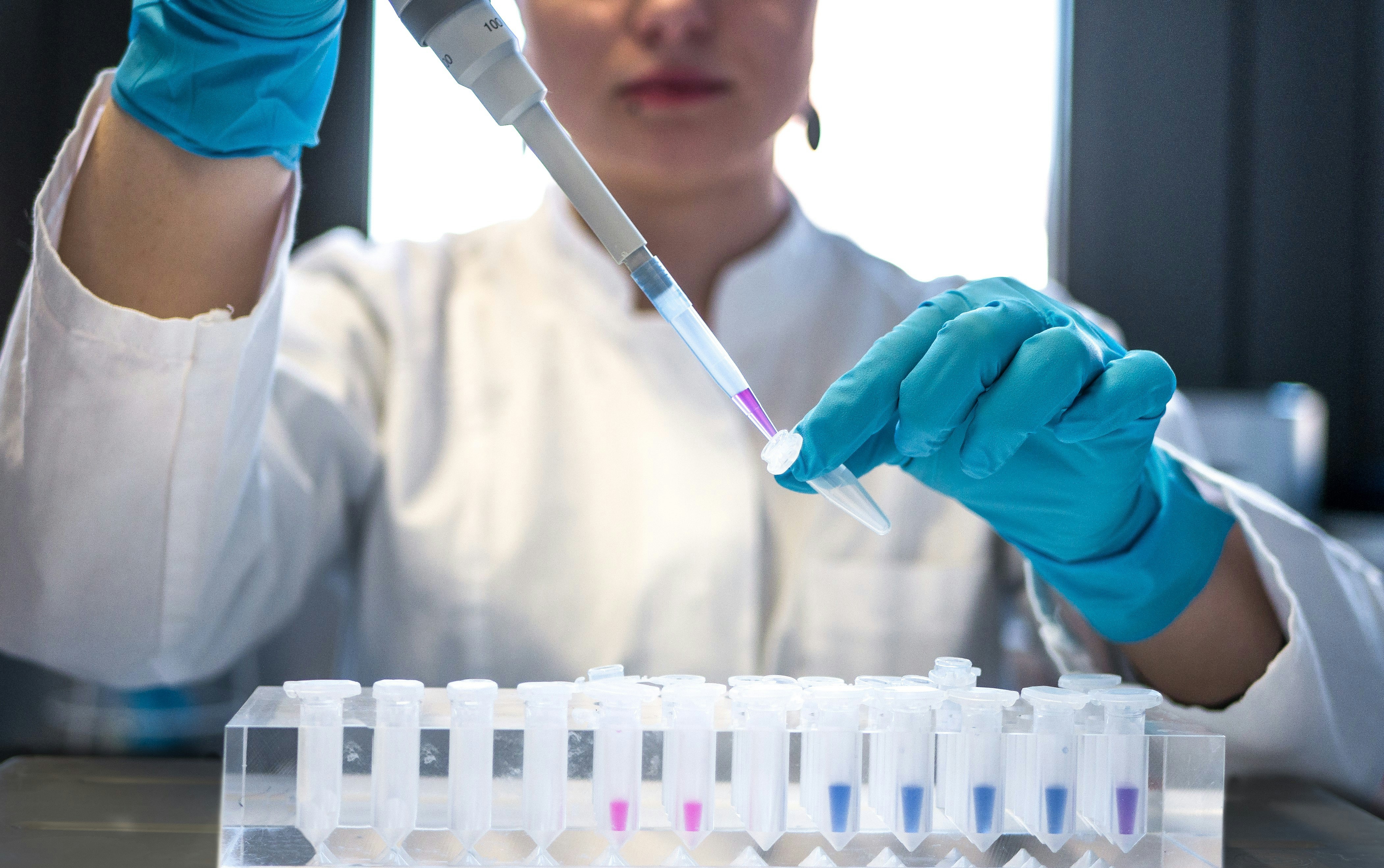
While outsourcing optimizes what you don't need to internalize, the circular economy optimizes what you keep in-house. And this is undoubtedly the most underutilized lever for laboratories today—even though it offers immediate gains.
A considerable source of savings
The observation is striking: a significant amount of perfectly functional equipment lies dormant in laboratories, technical centers, or educational institutions, set aside after a change in protocol, a reorganization, the end of a research project, or a relocation. This dormant inventory represents considerable, immobilized, and often forgotten value.
At the same time, the price of new equipment continues to rise, and manufacturer delivery times are increasing. Used or refurbished equipment offers a concrete solution: it can reduce the acquisition cost by 30 to 70%, depending on the type of equipment, while often offering much faster availability than new equipment. For a purchasing manager working under budget constraints, the difference is significant.
A major environmental issue
Beyond financial savings, reuse addresses a major environmental challenge. The scientific sector generates a significant amount of industrial and electronic waste. By extending the lifespan of equipment, laboratories reduce the disposal of still-functional devices, limit the accumulation of electronic and plastic waste, and decrease the overconsumption of raw materials. Manufacturing a new device requires energy and resources: choosing refurbished equipment directly reduces one's carbon footprint. This argument carries increasing weight in responsible purchasing policies.
How to secure a purchase of second-hand equipment?
However, buying used equipment requires rigorous quality and compliance checks—otherwise, the savings would turn into a risk. Properly refurbished analytical equipment must undergo several verifiable steps:
- a visual and mechanical inspection to detect any potential defects,
- the replacement of wear parts,
- calibration and validation according to current standards,
- Ideally, an IQ/OQ/PQ qualification accompanied by a traceable certificate.
- the availability of a history and technical data sheet for the device.
It is this rigor that distinguishes a true professional refurbishment from a simple resale of used equipment without a warranty. Before any purchase, demand traceability of quality controls, the possibility of obtaining a calibration report, the existence of a warranty, and the availability of spare parts.
Laboccaz: the marketplace for eco-friendly laboratory equipment
This is precisely the need that Laboccaz, the marketplace for used laboratory equipment,. The platform connects professional sellers — laboratories, manufacturers, distributors, repairers — and buyers — public laboratories, research centers, industrial companies — in a secure environment designed specifically for laboratory professionals.
Where Laboccaz truly stands out is in its role as a trusted intermediary. The platform doesn't hold the inventory; it facilitates direct transactions between professionals, with secure payment (via Stripe) that is only validated upon receipt of the goods in good condition, and integrated logistics to simplify delivery. This system provides security for both buyer and seller, and removes the main psychological barrier to buying used goods: the fear of unpleasant surprises. Beyond equipment, Laboccaz also allows for the repurposing of new but unused consumables—resulting from ordering errors or nearing their expiration date—which are too often wasted in traditional distribution channels.
The service even extends to complete recommissioning: thanks to a network of partners throughout France, the platform offers repair, decontamination, installation, commissioning, and qualification of equipment directly on-site. This meets the technical and regulatory requirements of laboratories while adhering to a concrete and traceable reuse approach. For a purchasing manager, this is a rare opportunity to reconcile three objectives often perceived as conflicting: budget control, compliance, and environmental commitment.
Lever 3: Pooling of resources
A third, more emerging but promising lever is resource sharing. Rather than each institution owning its entire equipment inventory, laboratories are now sharing technical platforms, heavy equipment, or specialized expertise. This shared platform model, already common in academia, is gradually gaining ground in the private sector. It allows access to cutting-edge instruments without bearing the sole cost of acquisition and maintenance, and smooths out periods of underutilization of expensive equipment. This is a priority avenue to explore for analyses requiring highly specialized equipment, complementing the two previous levers.
Are you looking for an analysis?
The hybrid approach: the agile laboratory of 2026
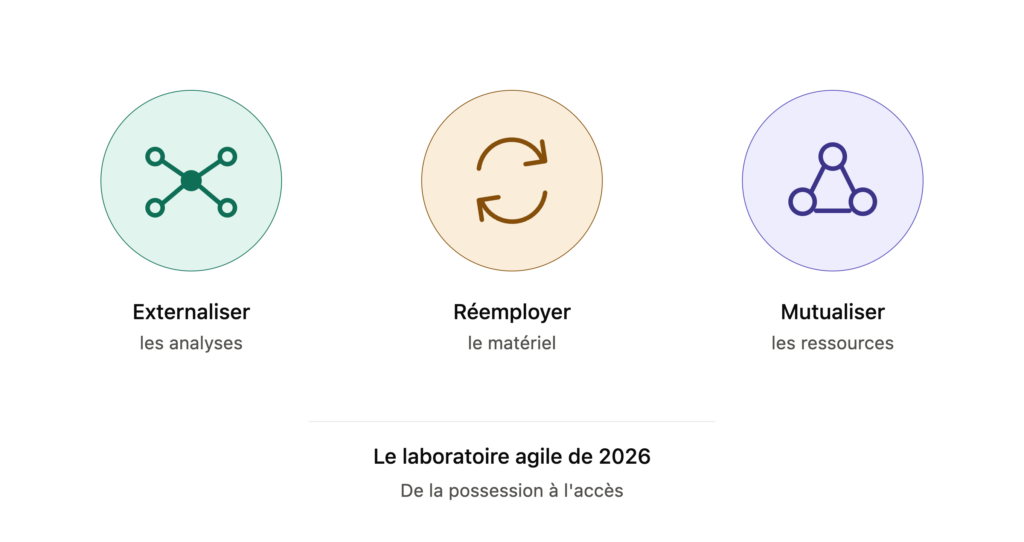
These three levers are not opposed: they are combined. Indeed, it is from their articulation that the truly optimized laboratory is born.
The natural reaction would be to oppose "outsourcing analyses" and "equipping oneself in-house." In reality, the agile laboratory of 2026 does both, but within different and complementary scopes. It outsources what is not its core business —non-routine tasks, peak workloads, analyses requiring expensive equipment or specific accreditation—to remain flexible and concentrate its resources where they matter most. And it optimizes its in-house equipment for recurring and strategic analyses, favoring high-quality refurbished equipment over systematically purchasing new. Resource sharing complements this system for very specific and occasional needs.
In practical terms, a laboratory manager in 2026 could: equip their routine workbench with refurbished and guaranteed instruments (immediate savings), outsource complex analyses performed only occasionally through a specialized intermediary (flexibility and compliance), and pool access to shared, cutting-edge equipment for a specific research project. This combination maximizes performance while minimizing capital expenditure and environmental impact.
In this context, Laboccaz and YesWeLab address two aspects of the same need : optimizing the resources of the modern laboratory. Laboccaz acts as a trusted intermediary for equipment; YesWeLab plays this role for analyses. Two B2B marketplaces, two specialized intermediaries, one shared philosophy: giving laboratories access to the right resources, at the right time, without unnecessary capital expenditure. One optimizes equipment, the other optimizes analytical capacity—and together, they are shaping the laboratory of tomorrow.
FAQ: Optimizing your laboratory in 2026
Should you outsource or insource your analyses? The answer depends on the volume, complexity, and frequency. Recurring, high-volume analyses that are central to your business are handled internally; ad-hoc, complex analyses, those requiring expensive equipment, or those needing specific accreditation are outsourced. Calculating the actual cost per sample (including depreciation, maintenance, and accreditation) allows you to make an objective decision.
Is used laboratory equipment reliable? Yes, provided it has been professionally refurbished. Properly refurbished equipment has been inspected, repaired if necessary, calibrated, and validated, with a warranty and traceability. Always request a calibration report, a service history, and, for regulated uses, an IQ/OQ/PQ qualification.
How much can you save with refurbished equipment? Depending on the type of equipment and its degree of refurbishment, the savings are generally between 30 and 70% compared to the price of new equipment, with often faster availability.
What is a B2B laboratory marketplace? It's a platform that connects professionals in the laboratory sector within a secure framework—for buying and selling used equipment, as with Laboccaz, or for accessing a network of analytical laboratories, as with YesWeLab. The common principle: a trusted third party that streamlines and secures exchanges between participants.
How can we reconcile budget optimization and CSR in the laboratory? By combining three key levers: outsourcing avoids unnecessary capital investments, reuse reduces waste and carbon footprint, and resource sharing optimizes the use of existing equipment. All three serve both economic performance and environmental objectives.
Optimizing your laboratory in 2026 isn't just about cutting budgets. It's about fundamentally rethinking what you internalize, what you outsource, what you buy new, and what you reuse. Targeted outsourcing, the circular economy, and resource sharing together create a more flexible, sustainable, and cost-effective model—a model that shifts from ownership to access, and from brand-new to optimally utilized equipment.
In this fundamental shift, Laboccaz and YesWeLab appear as two complementary building blocks of the same transformation. It is up to the technical and purchasing managers to use these levers to create the agile laboratory that meets their budgetary constraints, compliance requirements, and environmental ambitions.