Isoflavones are at the heart of many discussions in the fields of nutrition, health, and cosmetics. Naturally present in certain plants, particularly legumes, they generate both enthusiasm for their potential benefits and caution due to their hormonal effects.
In this article, we review the nature of isoflavones , their effects on health, official recommendations, and above all, the laboratory analyses that allow us to measure them rigorously, particularly through high-performance liquid chromatography (HPLC) , a reference method for the identification and quantification of plant compounds.
Particular attention will be paid to the challenges for manufacturers and to the analytical solutions offered by YesWeLab, an expert in the characterization of plant substances.
Table of Contents
What are isoflavones?
A subfamily of flavonoids
Isoflavones are natural compounds found in plants, belonging to the large family of flavonoids, polyphenols known for their antioxidant properties. More precisely, they form a specific subfamily: the isoflavonoids. Their chemical distinctive feature lies in the position of the phenyl group on their molecular skeleton: while flavones have this group in position 2, isoflavones have it in position 3, which alters their biological behavior.
This structural change gives isoflavones a very specific action: they are able to mimic the action of human estrogens by binding to hormone receptors. This is why they are called phytoestrogens : they are plant substances with pseudo-hormonal effects, without, however, being steroid hormones in the strict sense.
Molecules with an active biological role
Several major isoflavones have been identified in the plant kingdom, including:
- Genistein (5,7-dihydroxy-3-(4-hydroxyphenyl)-4H-chromen-4-one)
- Daidzeine (7-hydroxy-3-(4-hydroxyphenyl)chromen-4-one)
- Glycitein (7-hydroxy-3-(4-hydroxyphenyl)-6-methoxy-4-chromenone)
- Biochanin A , Formononetin , Tectorigenin , Calycosin , Prunetin , etc.
These molecules are naturally present in plant tissues, often in the form of glycosides (molecules conjugated to sugars), or derivatives such as malonates and acetates . These conjugated forms increase their solubility in water, but are unstable and rapidly hydrolyzed into aglycones (active free form) in the body.
Their biological activity varies according to their structure, bioavailability, and individual metabolism. For example, some isoflavones can be transformed by the gut flora into equol , a metabolite with more potent estrogenic effects, but this conversion only occurs in certain individuals depending on their microbiota.
Growing interest in the agri-food, health and cosmetics sectors
Thanks to their estrogen-like effects, isoflavones are of particular interest to the nutraceutical for the formulation of hormonal supplements, especially for menopausal women. Their antioxidant properties and their potential to regulate inflammatory responses also make them attractive in cosmetic formulations , for improving skin elasticity or strengthening hair fibers.
In the agri-food sector , they are naturally found in soy-based foods and other legumes, but their presence requires strict control due to their potential effects on human health. Hence the growing interest in their laboratory quantification, whether to assess regulatory compliance or to formulate safely fortified products.

Where are isoflavones found naturally?
Legumes, the main plant-based sources
Isoflavones are present in many plants, but only certain species contain them in significant concentrations. The Fabaceae , commonly known as legumes, are the main natural sources of isoflavones.
Among the richest plants are:
- Soybeans (Glycine max), a true benchmark in terms of isoflavone content, including genistein, daidzein and glycitein .
- Red clover ( Trifolium pratense), rich in biochanin A and formononetin.
- Kudzu (Pueraria lobata), used in some Asian pharmacopoeias .
- Alfalfa shoots ( Medicago sativa), mung beans , green beans , voem (Vigna unguiculata), and psoralea (Psoralea corylifolia), often used in herbal medicine.
Significant concentrations are also found in chickpeas , peanuts , and certain medicinal roots . However, the amounts of isoflavones vary depending on the plant species, genotype, growing conditions, and the plant's stage of development.
Forms of isoflavones in plants
In plant tissues, isoflavones are mainly found as glycosides (isoflavones linked to a sugar), and sometimes as malonates or acetyl conjugates . These soluble forms are easily transported within the plant, but are unstable: they degrade during heat treatments or digestion, releasing the active aglycone forms.
This process strongly influences the bioavailability of isoflavones in the human body, that is, their ability to be absorbed, metabolized, and to exert their physiological effects.
The concentration varies greatly depending on the food.
The isoflavone content of foods depends on their plant origin but also on the processing method. Certain processes, such as fermentation , can significantly influence the amount of isoflavones remaining in the final product.
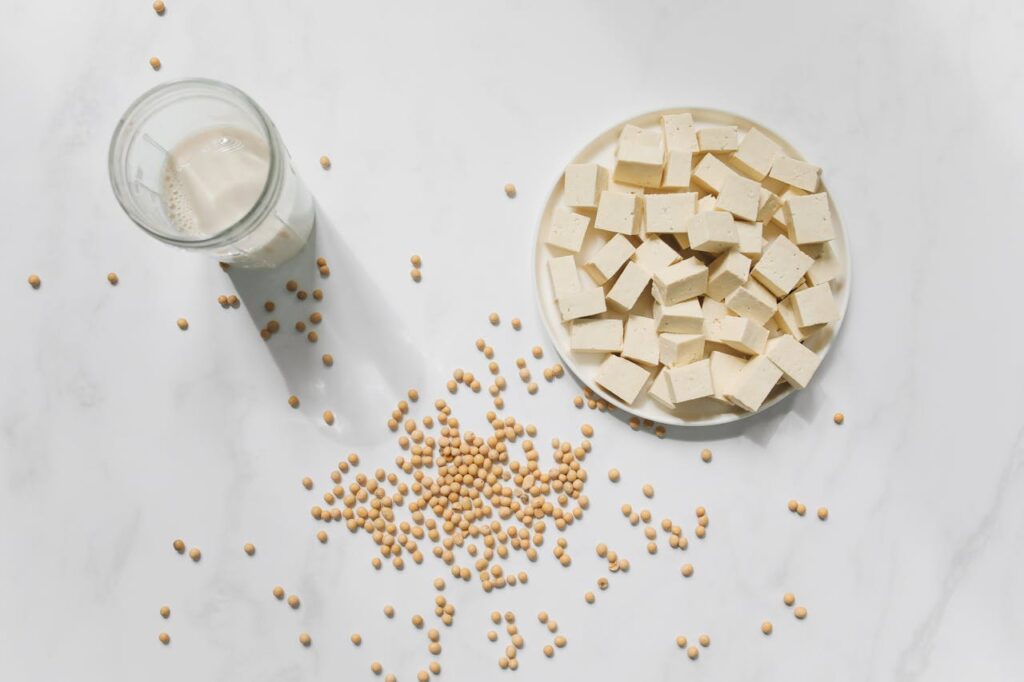
Here are some examples of products classified according to their average concentration of isoflavones (in mg per 100 g of food):
- Plain tofu : 20 to 40 mg
- Natto (fermented soy): 50 to 100 mg
- Tempeh : 40 to 80 mg
- Soy milk : 10 to 30 mg
- Textured soy protein (raw) : 120 to 180 mg
- Roasted soybeans : up to 200 mg
highly processed soy-based foods (snack biscuits, vegetarian ready meals, soy protein isolates) are often the most concentrated in isoflavones, sometimes exceeding the recommended thresholds for daily consumption.
The special case of miso and fermented foods
Contrary to popular belief, fermented soy-based foods like miso or tamari can sometimes contain higher levels of isoflavones due to the concentration of soy during fermentation. The type of fermentation (bacterial or fungal), its duration, and temperature also play a role in the structure and transformation of the isoflavones.
Fermentation also releases the active forms (aglycones), which can increase their bioavailability. This process is therefore a double-edged sword: it can reduce the total isoflavone content while simultaneously increasing the proportion of active forms available to the body.
A database for food products
To help professionals assess the actual isoflavone content of processed foods, databases have been compiled by international organizations such as the USDA. These databases allow for better prediction of daily intake, particularly for vulnerable populations (children, pregnant women, regular consumers of soy products).
This quantification work is essential to guide nutritional recommendations, adapt industrial formulations and limit the risks of excessive exposure.
Are you looking for an analysis?
What regulations govern isoflavones?
Strict French recommendations
In France, isoflavone consumption is regulated by official recommendations, notably those issued by AFSSA in 2005 (now ANSES ). The agency recommends not exceeding a maximum dose of 1 mg of isoflavones per kilogram of body weight per day . This means, for example, that a person weighing 70 kg should not consume more than 70 mg of isoflavones per day .
These recommendations apply to both isoflavones naturally present in food and those included in dietary supplements. They aim to limit the risks associated with chronic exposure, particularly the endocrine disruptions mentioned earlier.
ANSES stressed the importance of taking into account all food sources in the calculation of daily intakes, including processed foods, which are often forgotten in estimates.
Special attention should be paid to processed products.
A major problem in complying with these recommendations lies in the large variability of isoflavone concentration in foods, particularly in processed soy products.
Analyses conducted by health authorities have revealed that some commercially available products can significantly exceed the recommended daily intake , especially with regular consumption. For example:
- Some soy-based snack crackers can contain up to 100 times more isoflavones than traditional soy sauce .
- Soy protein isolates , widely used in industrial vegetarian products (patties, steaks, nuggets, drinks), highly concentrate isoflavones due to their processing.
food safety concerns , particularly for children and pregnant women , who are especially vulnerable to hormonal disruptions. ANSES recommends avoiding regular consumption of soy products by children under 3 years old and urges vigilance among pregnant and breastfeeding women .
Isoflavones and dietary supplements
The market for isoflavone-enriched dietary supplements, often marketed for menopause , is booming. However, these products must comply with regulatory limits .
In France, although isoflavones are not yet subject to harmonized regulations at the European level , the authorities impose:
- recommended daily intake limits per
- Mandatory information on packaging intended to warn consumers (e.g., not recommended for pregnant women, children, or people with hormonal disorders).
In the event of non-compliance, these products may be subject to batch recalls or health alerts .
Laboratory analysis and regulatory compliance
To ensure compliance with these recommendations, manufacturers and formulators must have the isoflavone content of their products analyzed in accredited laboratories . These analyses allow for:
- Check the actual concentration of isoflavones in the raw material or finished product,
- Assess the potential consumer exposure at different doses according to the recommended portion size.
- Document the regulatory files to be submitted to the authorities in the event of an audit.
These analyses are particularly crucial in the following sectors:
- Nutraceuticals : to validate formulations and avoid overdoses in supplements.
- Agri-food : to monitor concentrations in soy-based products (tofu, drinks, snacks).
- Cosmetics : when a product contains plant extracts rich in isoflavones that can migrate through the skin.
ISO 17025 accredited laboratories and, where possible, COFRAC , in order to ensure the reliability, traceability and regulatory acceptance of the results.
Towards European harmonization?
Currently, there is no specific European regulation dedicated to isoflavones, which leaves Member States some latitude in managing safety thresholds and health claims.
However, the development of the plant-based protein market and the increasing popularity of soy-based products could accelerate the harmonization of regulations , particularly on the following points:
- Definition of a maximum European daily dose ,
- Regulation of isoflavone-based food supplements ,
- Update of INCO regulations on labelling and claims related to phytoestrogens.
Until then, manufacturers must exercise caution , relying on existing national standards, conducting regular analyses , and adjusting their formulations according to the profiles of targeted consumers.

How are isoflavones analyzed in the laboratory?
A key analytical challenge for manufacturers
With the rise of plant-based products, dietary supplements, and plant-based alternatives to milk or meat, isoflavone measurement has become a major issue for many industrial sectors. Whether in the food, nutraceutical, or cosmetics industries, it is essential to accurately quantify these compounds in order to:
- to ensure regulatory compliance ,
- to validate health claims ,
- to control the quality of raw materials ,
- to control the concentrations in the finished products .
Specialized laboratories use advanced analytical techniques capable of detecting different forms of isoflavones, even in trace amounts, in various matrices.
High-performance liquid chromatography (HPLC-UV)
The most commonly used method for the determination of isoflavones is HPLC -UV , or high-performance liquid chromatography coupled with a UV detector .
This technique allows you to:
- separate the different isoflavones (genistein, daidzein, glycitein, etc.),
- quantify each molecule independently,
- reaching low limits of quantification , sometimes around 10 ppm (parts per million).
Example of analysis:
A laboratory can analyze a product like tempeh by extracting isoflavones and measuring their concentration using HPLC-UV. This method is particularly precise, reproducible, and conforms to international standards (AOAC, ISO).
The COFRAC-accredited internal method
Some French laboratories, such as ITERG, have developed internal methods based on the AOAC standard, but adapted to specific matrices such as:
- plain tofu,
- soy milk,
- fermented plant-based desserts,
- vegetarian patties and burgers,
- soy concentrates or powdered sprouts.
This method was accredited by COFRAC in 2021, guaranteeing its reliability and official recognition . It allows for precise quantification of the 12 main isoflavones , including in complex processed products.
Other complementary analytical methods
- Spectrophotometry : Used in simpler contexts, this method relies on measuring the absorbance of a sample. Less specific than HPLC, it is sometimes used for preliminary analyses.
- LC-MS (liquid chromatography coupled with mass spectrometry) : used for very fine analyses or to confirm the identity of isoflavones in complex matrices.
Examples of analyzed matrices
Isoflavones can be measured in a wide range of plant materials or finished products . The most common matrices analyzed in the laboratory include:
- Foods : tofu, tempeh, soy drinks, flours, concentrates, plant-based desserts.
- Dietary supplements : dry soy extracts, capsules, tablets, vegetable powders.
- Cosmetic products : creams, lotions, serums containing red clover or soy extracts.
- Raw materials : sprout powders, whole seeds, standardized plant extracts.
Standards, accreditations and the importance of traceability
Laboratory analyses of isoflavones must be carried out in compliance with strict standards , ensuring the reliability of the results and their acceptance by regulatory authorities.
- ISO 17025 : an international standard that defines the competence requirements for analytical laboratories. It is essential to guarantee the quality of the methods used.
- COFRAC accreditation : in France, this accreditation provides official recognition and demonstrates that the laboratory is capable of providing valid and traceable results.
- AOAC standards : these American standards are often used as a reference for dosage methods in the food and dietary supplement industry.
Compliance tests thus allow us to:
- to ensure the safety of finished products,
- anticipate regulatory controls,
- validate isoflavone levels in health claims,
- avoid exceeding thresholds for at-risk populations.
Why have your products analyzed for isoflavones?
Having isoflavones analyzed by a specialized laboratory allows for:
- to ensure your products comply with ANSES recommendations and market expectations,
- to control health and regulatory risks ,
- to adjust your formulations to ensure a good balance between efficacy and safety,
- to document your products as part of a quality or certification process.
Whether you are a food supplement manufacturer , food industrialist , or cosmetic formulator , laboratory analysis is a key step to secure your productions and protect your consumers .

Isoflavones and industrial sectors: what are the challenges for professionals?
The agri-food industry: content control and safe formulation
soy -based products and, more broadly, in vegetarian and vegan products. The increasing popularity of these plant-based alternatives in consumers' diets is leading manufacturers to precisely control isoflavone levels in their finished products.
The challenges for manufacturers are numerous:
- Compliance with health recommendations : in particular to avoid exceeding regulatory thresholds in children and pregnant women.
- Adaptation of formulations : according to the profiles of consumers targeted (sensitive public, athletes, elderly people).
- Compliance of nutritional claims : for example, the statement “source of phytoestrogens” requires a precise dosage.
Certain products such as vegetable patties , textured soy protein , fortified plant-based drinks , or baby food require increased monitoring because they can concentrate isoflavones well beyond the levels naturally present in seeds.
The nutraceutical sector: standardization of extracts and health claims
The market for isoflavone-based food supplements is booming, particularly in the following areas:
- Menopause support
- Cardiovascular health
- Bone health
- Prevention of cellular aging
In this context, manufacturers must ensure that:
- Standardize their extracts (e.g., “soy extract standardized to 40% isoflavones”),
- Mastering active molecular forms (aglycones vs glycosides),
- Demonstrate bioavailability and efficacy through precise analyses,
- Avoid overdoses which may harm the hormonal profiles of some consumers.
A poorly formulated or incorrectly dosed supplement can not only lose its effectiveness but also pose a health risk. Nutritional and health claims must be supported by rigorous laboratory analyses and, in some cases, by clinical studies or regulatory opinions (EFSA, ANSES).
Plant-based cosmetics: promoting extracts rich in isoflavones
Isoflavones are also attracting increasing interest from the cosmetics , particularly in the following product ranges:
- anti-aging (firming, skin elasticity),
- hormonal anti-acne (sebum regulation),
- capillaries (fiber strengthening, growth stimulation),
- Bust care (tightening effect).
These products often contain plant extracts rich in isoflavones, such as red clover , soy , or alfalfa . To guarantee product quality, laboratories must:
- to precisely characterize the isoflavone content of the extract used,
- check the stability of molecules in formulas (especially in the case of emulsions, acidic pH, or exposure to light),
- ensure safety of use on the skin , particularly for sensitive skin or hormone-dependent areas.
Cosmetic products containing isoflavones must meet the requirements of Regulation (EC) No 1223/2009 , which mandates a safety assessment, including the toxicology of active plant substances.
Enhanced traceability for plant-based raw materials
Regardless of their sector, manufacturers must now integrate the concept of analytical traceability into their supply chain management. This implies:
- to know the botanical source (species, part used),
- to verify the geographical origin and growing conditions,
- to carry out regular analytical testing of incoming batches.
Isoflavone content can vary significantly from batch to batch depending on the plant variety, climate, harvest maturity, and drying processes. Only reliable laboratory analyses can ensure the safety of the production chain and prevent uncontrolled variations in concentration.

YesWeLab, your partner for isoflavone testing
A network of more than 200 partner laboratories
YesWeLab leverages a network of over 200 specialized laboratories across France and Europe to offer high-quality analyses in diverse fields such as food, nutraceuticals, cosmetics, the environment, and materials. This collaborative approach allows users to quickly find an expert laboratory for isoflavone analysis, regardless of the complexity of the matrix or product.
Thanks to this structured network, YesWeLab is able to offer optimized lead times , validated methods, and analytical flexibility adapted to the specific needs of manufacturers.
One of YesWeLab's greatest strengths is its all-in-one digital platform , designed for professionals. With this tool, you can:
- search and select the analysis you need (more than 10,000 references available),
- Get an instant quote based on your matrix.
- Order your analyses online and send your samples in just a few clicks.
- track the processing of your samples in real time,
- Receive your results directly in your secure client area.
This digital approach makes it possible to significantly reduce delays and ensure complete traceability of results , while facilitating exchanges between your R&D, quality, or regulatory teams, and the laboratories concerned.