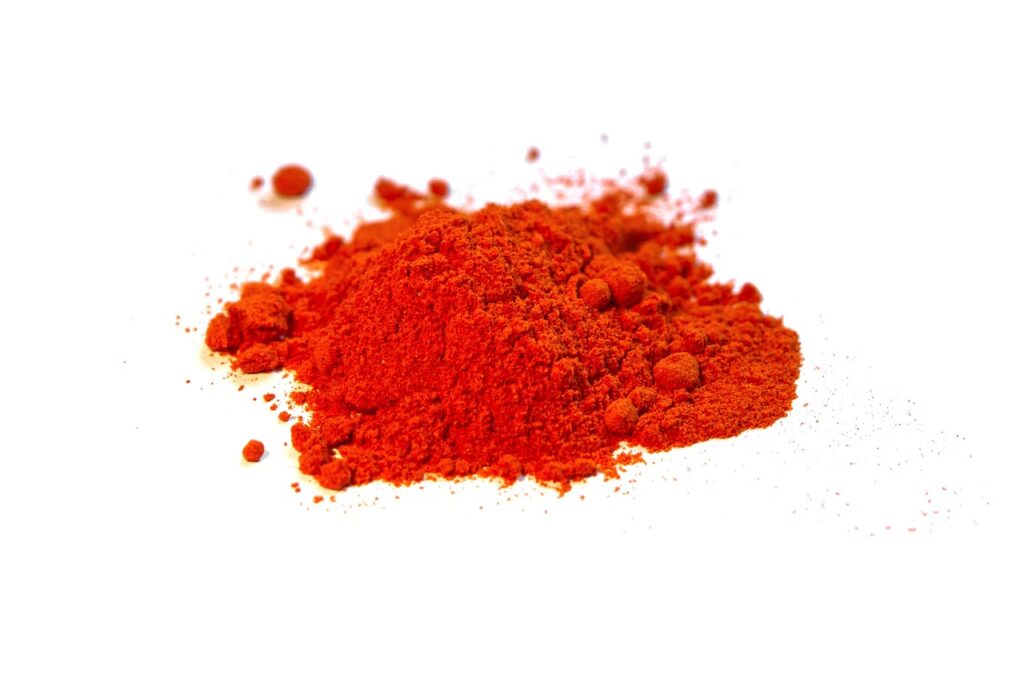
The food additive E160c, more commonly known as paprika extract, is a natural coloring agent that gives food an intense and appealing red color. Derived from paprika pigments, this coloring agent belongs to the carotenoid family and is valued in the food for its aesthetic properties. Its growing popularity stems from its ability to enhance the colors of food products while meeting consumer preferences for naturally sourced ingredients. In this article, we will explore in detail the composition of E160c, its manufacturing processes, its applications, as well as the regulations and laboratory analyses that ensure its safety.
What is E160c?
Definition and origin of paprika extract
E160c, also known as capsorubin, is a coloring agent extracted from paprika, a variety of sweet pepper belonging to the species Capsicum annuum . This pigment is naturally present in the skin and pulp of paprika fruits, giving them their characteristic bright red hue. As a carotenoid, capsorubin is associated with plant pigments responsible for a range of colors, from yellow to orange and red. The paprika extract used as a coloring agent is composed primarily of capsanthin and capsorubin, two pigments particularly rich in red hues, making it a preferred choice for coloring food.
The history and use of E160c in the food industry
The use of natural pigments in food dates back centuries, but the use of paprika extract as a food additive became popular more recently, with the rise of the modern food coloring industry in the 20th century. E160c is widely used for its ability to enhance the color of food, a major advantage for processed products. On supermarket shelves, it is common to find E160c in confectionery, pastries, prepared meals, and even some meat products such as deli meats.
In addition to its visual appeal, E160c meets current consumer expectations. Indeed, consumers are increasingly attentive to food labels and favor natural ingredients over synthetic colorings. Thanks to its natural source, paprika extract is perceived as a healthier and more environmentally friendly option, an important factor in the choices of both manufacturers and consumers.
What is paprika extract made of?
E160c, paprika extract, owes its coloring properties to a composition rich in carotenoids, natural pigments found in many plants. These biochemical compounds offer a range of colors from yellow to bright red, depending on their chemical structure and concentration. In the case of paprika extract, the main pigments are capsanthin and capsorubin, but other carotenoids also contribute to its unique hue and properties. This section examines in detail the composition of paprika extract, its active components, and their roles in nutrition.
Capsanthin and capsorubin: the dominant pigments
Capsanthin and capsorubin are the two major carotenoids that give E160c its intense red color. These pigments are naturally present in paprika fruits, where they act as protective molecules, absorbing light to shield plant cells from UV damage. As food additives, they perform a similar function by absorbing light and reflecting reddish hues that enhance the visual appeal of products.
- Capsanthin : This carotenoid is the most abundant component in E160c, responsible for the red-orange color of paprika. Capsanthin is particularly stable in food matrices, making it an excellent choice for products requiring intense and long-lasting color.
- Capsorubin : Another essential pigment in paprika extract, capsorubin, provides slightly darker shades and contributes to the deep visual effect desired in certain food preparations. Like capsanthin, it is known for its stability and coloring effectiveness under industrial conditions.
Other carotenoids present in paprika extract
In addition to capsanthin and capsorubin, E160c contains a variety of other carotenoids, although these are present in smaller quantities. These additional pigments, such as beta-carotene and lutein, play a complementary role, enriching the overall hue and intensity of the colorant. While less dominant, these carotenoids enhance the perception of freshness and naturalness in food products.
- Beta-carotene : Known for its bright orange color, beta-carotene is a common pigment in fruits and vegetables. In E160c, it contributes slightly to the overall hue, adding a warmer, more natural note.
- Lutein : Present in small quantities, lutein adds a touch of yellow, balancing the colour spectrum of the dye and adding depth.
The potential health benefits of carotenoids
In addition to their coloring properties, the carotenoids present in E160c, such as capsanthin and beta-carotene, are also being studied for their potential health benefits. Carotenoids are natural antioxidants, meaning they can help protect human cells from damage caused by free radicals. While E160c is primarily used for its color, its composition may offer additional benefits to consumers when incorporated into food products.
How is the E160c manufactured?
The production of E160c, a paprika extract, relies on a precise extraction process designed to obtain a pigment-rich colorant while maintaining its stability and effectiveness in food products. This process uses industrial techniques that preserve the natural properties of paprika while ensuring the concentration of capsanthin and capsorubine, the main carotenoids responsible for the characteristic red color of E160c. This section explores the manufacturing steps of paprika extract, from the selection of raw materials to the production of a concentrated and purified extract.
Selection of raw materials
The quality of the E160c coloring agent depends directly on the quality of the raw materials used. Manufacturers carefully select high-pigment paprika (Capsicum annuum) fruits to guarantee an optimal concentration of capsanthin and capsorubin. These peppers are grown under controlled conditions to ensure optimal growth and maximum accumulation of carotenoids. The paprikas are harvested when they reach full maturity, which is when they contain the highest amount of pigment.
Pigment extraction process
Once the paprika fruits have been selected and prepared, the key step of pigment extraction begins. Carotenoid extraction is generally carried out using organic solvents such as hexane or acetone, compounds that are effective at dissolving carotenoids while preserving their chemical integrity.
- Fruit preparation : Paprika fruits are first washed, dried and ground into a fine powder to increase the surface area in contact with the solvent and facilitate extraction.
- Solvent extraction : Paprika powder is immersed in an organic solvent, which dissolves the carotenoids present in the plant material. This mixture is then heated to accelerate pigment extraction.
- Filtration and solvent recovery : Once the carotenoids have been extracted, the mixture is filtered to separate the solid particles from the liquid containing the dissolved pigments. The solvent is then removed by vacuum evaporation, leaving a concentrated extract of capsanthin and capsorubin.
Purification and concentration of the extract
After initial extraction, the paprika extract undergoes purification to remove solvent residues and unwanted impurities. This step is crucial to ensuring the safety and purity of E160c for food use. Purification is achieved through additional filtration and separation methods, aiming to obtain a colorant free of contaminants and compliant with food safety standards.
- Solvent evaporation : Any residual trace of solvent is removed to ensure that the final extract contains only the desired pigments.
- Pigment concentration : The final product is often concentrated to obtain a high content of capsanthin and capsorubin, ensuring an intense and stable color, even in low dosages in food products.
Quality controls for a compliant dye
At each stage of the process, rigorous quality controls are performed to ensure that the paprika extract meets food safety standards and purity requirements. Laboratories conduct concentration tests to verify capsanthin and capsorubin levels, while also screening for the presence of contaminants. These controls ensure a final product that meets industry standards, providing consistent quality for food manufacturers.
Uses of E160c in the food industry
E160c, or paprika extract, is highly valued in the food industry for its intense, natural red color, which enhances the visual appeal of many products. Its natural source and color profile make it a preferred colorant for brands seeking to meet consumer demand for products free of artificial additives. In this section, we explore the various applications of E160c in the industry, as well as its advantages for manufacturers.
Food products commonly colored with E160c
E160c is used in a wide range of food products. This coloring is valued for its ability to stabilize and intensify red, yellow, and orange hues, while blending seamlessly into recipes without altering the flavors of the food.
- Confectionery and pastries : In confectionery, E160c is often used to color candies, gums, and jellies, where it provides a bright red hue that captures the attention of consumers, especially children. In pastries, it is used to enhance the color of fillings, icings, and creams.
- Canned fruits and vegetables : For canned vegetables, such as peppers and tomatoes, E160c is used to maintain an appetizing color despite the preservation process, which can alter the natural color of the ingredients.
- Processed meats : In some processed meat products, such as sausages and pâtés, E160c is used to enhance the natural color, giving the products a fresh and appetizing appearance. This coloring is valued for its homogeneity and stability.
- Dairy products and plant-based alternatives : In dairy products such as flavored yogurts and cheeses, as well as in plant-based alternatives, E160c adds a touch of color without impacting the taste, thus meeting consumer demands for natural ingredients.
- Prepared dishes and potato products : For cooked dishes, such as stews and dishes with sauce, or in products such as seasoned chips, E160c enhances the color of the ingredients and adds an attractive visual aspect that makes people want to consume it.
Why is E160c valued in the food industry?
The properties of E160c make it a popular food additive among manufacturers, for both aesthetic and practical reasons. Here are the main advantages that explain its success in the industry:
- Natural source : E160c is of plant origin, which aligns with current trends towards products without synthetic dyes. Today's consumers are increasingly concerned about the ingredients used, and using a dye derived from paprika provides a guarantee of naturalness.
- Stability in food matrices : Unlike some natural colorings, E160c is relatively stable and resistant to light, heat, and the varying pH of food. This ensures a uniform and long-lasting color, even in processed products and prepared dishes.
- Flexibility of use : E160c integrates easily into a wide variety of products, offering a broad range of red and orange hues without altering the taste of food. This makes it a versatile choice for manufacturers.
- Appealing appearance for consumers : By adding a bright, natural color, E160c enhances the attractiveness of products on store shelves. Food with intense colors is perceived as more appetizing, which can positively influence consumers' purchasing decisions.
E160c regulations and safety
The use of E160c in food products is governed by strict regulations to ensure consumer safety. As a natural additive, E160c is generally well-received by regulatory bodies, but its use is subject to specific rules regarding dosage and the types of products in which it can be used. This section examines the regulations in force for E160c, its acceptable daily intake (ADI), and the safety aspects related to its consumption.
The acceptable daily intake (ADI) of E160c
The acceptable daily intake (ADI) is a key parameter for assessing the safety of a food additive. It represents the maximum amount of a substance that consumers can ingest daily without risk to their health, based on their body weight. For E160c, this ADI is set at 24 mg per kilogram of body weight .
This limit is considered safe and incorporates safety margins, even for consumers who regularly include foods containing E160c in their diet. In practice, this ADI allows for fairly widespread use of E160c in food products, while ensuring consumer protection.
European and international regulations
In Europe, the use of E160c is governed by Regulation (EU) No 1333/2008 , which sets standards for food additives in products intended for human consumption. This regulation authorizes the use of E160c in specific categories of food products, respecting the maximum permitted levels for each type of product. This regulation is supplemented by other national directives and by regular adjustments based on safety studies conducted by the EFSA (European Food Safety Authority).
Internationally, regulations for E160c vary from country to country, but it is generally accepted as a natural coloring agent in most jurisdictions. In the United States, for example, the FDA (Food and Drug Administration) authorizes the use of paprika extract in food products but imposes similar restrictions regarding dosage and applications.
Use of E160c in organic products
Despite its natural source, E160c is not permitted in organic products in many regions, including the European Union. Organic certification standards require ingredients to be of certified organic origin, and the use of solvents or industrial extraction methods may disqualify E160c from this category. Consequently, manufacturers of organic products must turn to alternative coloring options or prioritize additive-free processes.
Safety and potential side effects
E160c is generally considered safe when used according to recommended doses. It is not associated with any known allergic effects, making it an accessible coloring for the majority of consumers, including those with food allergies.
However, excessive consumption of carotenoids, particularly in amounts well above the ADI (Acceptable Daily Intake), could theoretically lead to side effects, such as an orange discoloration of the skin, known as carotenemia . While this condition is harmless and reversible, it underscores the importance of adhering to recommended doses. With normal consumption of food products containing E160c, however, these side effects are extremely rare.
Are you looking for an analysis?
Laboratory analysis of E160c
Laboratory analysis of E160c is essential to ensure the quality, concentration, and safety of this food additive in consumer products. In the industry, analytical methods allow for the precise quantification of capsanthin and capsorubin levels, the two main carotenoids in E160c, thus ensuring that products meet regulatory requirements. This section focuses on the HPLC-DAD quantification method, the most commonly used for analyzing E160c in food matrices, detailing its operation, advantages, and limitations of quantification.
The HPLC-DAD quantification method
chromatography with diode array detectors (HPLC-DAD) is the reference method for the analysis of carotenoids, particularly E160c, in food products. This separation and quantification technique is especially well-suited to non-volatile compounds such as carotenoids, offering high precision and sensitivity.
- How HPLC-DAD Works : The HPLC-DAD method relies on separating the sample components within a chromatographic column, where the pigments interact with the stationary and mobile phases. The diode array detector (DAD) enables multi-wavelength detection, which is essential for identifying and quantifying carotenoids, which absorb light in specific spectra.
- Capsanthin and capsorubin quantification : This method allows for the precise quantification of capsanthin and capsorubin concentrations in the E160c sample. These measurements are essential to ensure that the pigment concentration meets safety standards and manufacturers' expectations, thus guaranteeing a quality product.
Advantages of the HPLC-DAD method for E160c
HPLC-DAD is the preferred method for several reasons:
- High precision : HPLC-DAD offers superior accuracy in measuring capsanthin and capsorubin concentrations, allowing laboratories to accurately determine pigment content.
- Multi-wavelength detection capability : The DAD detector is capable of reading absorptions at different wavelengths simultaneously, which is crucial for identifying and quantifying multiple pigments present in E160c.
- Robustness and reliability : HPLC-DAD is a proven method, recognized for its reliability and reproducibility in the analysis of carotenoids, even in complex food matrices.
Limits of quantification and laboratory requirements
HPLC-DAD analysis provides a limit of quantification (LOQ) of approximately 0.1 to 2 mg/kg, depending on the food matrix analyzed. This sensitivity ensures that E160c is present in safe concentrations that meet quality requirements. To perform this analysis, laboratories collect samples meticulously, often on sealed and inert supports, to preserve the integrity of the pigments during transport and analysis.
In short, the HPLC-DAD method is essential for laboratories seeking to analyze the quality and concentration of E160c in food products. Thanks to this advanced technology, manufacturers and regulators can ensure that the colorings used meet safety and purity standards, thus guaranteeing consumer satisfaction and safety.
Comparison with other food colorings
In the food industry, E160c is not the only carotenoid-derived colorant; it is one of a wide range of natural pigments used to color products attractively. Other colorants such as E160a (β-carotene), E160b (annatto), and E160d (lycopene) share some characteristics with E160c, but each has specific properties that influence their applications. This section examines the differences between E160c and other carotenoid colorants, their respective properties, and the reasons why E160c may be preferred in certain food formulations.
E160a (β-carotene)
E160a , or beta-carotene, is one of the most commonly used colorings in food products, and it is known for its bright orange color. Beta-carotene is also recognized as a provitamin A, meaning it is converted into vitamin A in the body, making it beneficial for eye and immune health .
- Colour and stability : E160a produces an orange rather than red tint, making it an ideal choice for products that require a warm but not red colour, such as drinks, sauces or soups.
- Applications : Used in many dairy products, pastries and fruit juices, β-carotene is often preferred for its nutritional properties and wide regulatory acceptance.
- Limitation : Its specific color limits its use in products that require an intense red, making E160c more suitable in these cases.
E160b (Roucou)
E160b it is slightly less stable than E160c in some applications.
- Colour and intensity : Annatto produces a reddish-orange tint, but its stability can be affected by heat and acidity, which limits its use in certain types of products.
- Applications : It is commonly found in cheese (such as cheddar) and baked goods, where its added color gives an appetizing and uniform appearance.
- Limitation : Its lower stability compared to E160c makes it less suitable for products where resistance to heat and light is crucial.
E160d (Lycopene)
E160d , or lycopene, is an intense red pigment naturally found in tomatoes and other red fruits. This carotenoid is known for its antioxidant properties and is sometimes used for its vibrant color as well as its potential health benefits .
- Colour and stability : Lycopene offers a dark red colour similar to E160c, but it is often less stable, especially in acidic environments or when exposed to prolonged heat.
- Applications : Used primarily in sauces, soups and prepared tomato-based dishes, lycopene adds a natural color and is particularly appreciated for products whose labeling highlights tomato-based ingredients.
- Limitation : Lycopene's sensitivity to processing conditions makes it less versatile than E160c, especially for products requiring high stability.
Why is the E160c preferred in certain applications?
E160c is particularly valued in applications requiring a deep, stable red color, especially for products that must withstand heat and light without color alteration. Its stability makes it a preferred choice in confectionery, processed meats, and prepared foods where visual appeal is paramount. Unlike some other carotenoids, E160c offers a more intense red hue, distinguishing it from beta-carotene or annatto.
Furthermore, the natural perception of E160c as paprika extract enhances the appeal of the products in which it is used, meeting the growing consumer demand for simple and natural ingredients. E160c thus finds its place on store shelves, offering a bright and attractive color while meeting expectations for naturalness and food safety.
Future prospects for E160c in the food industry
With growing demand for natural products and increased ingredient transparency, E160c continues to establish itself as a preferred colorant in the food . Due to its natural source and stability properties, E160c aligns perfectly with current consumer trends that favor plant-based additives and sustainable solutions. This section explores the future prospects for E160c, including innovations in its production, research into its potential health benefits, and consumer expectations for more natural food.
Innovations in extraction processes
Traditional methods for extracting E160c use organic solvents such as hexane and acetone to isolate the pigments, but recent technological advances are paving the way for more environmentally friendly extraction processes. Research is focusing on alternative techniques, such as supercritical CO₂ extraction, which allows for the more environmentally sound isolation of carotenoids, without solvent residues. This method, while costly, could meet the expectations of manufacturers and consumers for purer, responsibly produced ingredients.
Innovations in extraction processes also aim to increase the yield of capsanthin and capsorubin, the main components of E160c, thereby reducing production costs while meeting the growing demand for natural colorants. Furthermore, "clean" extraction technologies could open new avenues for allowing E160c in organic products, meeting the stringent requirements of organic certification.
Research on the health benefits of carotenoids
In addition to its coloring properties, E160c, as a source of carotenoids, is attracting research interest for its potential antioxidant benefits. Carotenoids such as capsanthin and capsorubin are known for their ability to neutralize free radicals, which could offer health benefits, particularly in terms of cell protection and reducing the risk of chronic diseases. Research is ongoing to determine whether the pigments present in E160c could have beneficial effects similar to those of beta-carotene or lycopene, whose antioxidant properties are already well documented.
In the future, scientific discoveries regarding the beneficial effects of carotenoids could enhance the appeal of E160c as a value-added food coloring, combining visual appeal with health benefits. This could also open the door to new applications in the dietary supplement and functional food sectors.
Evolving consumer expectations
Consumer demand for natural and sustainable products directly impacts manufacturers' ingredient choices. E160c, as a paprika extract, meets these requirements by offering a vibrant, natural color that aligns with the "clean label" trend. Consumers increasingly favor simple, transparent labels, and a paprika-derived coloring agent is easily recognizable and accepted by the general public.
The future of E160c therefore looks promising, with increased adoption in a variety of products and potential expansion into new product categories. As consumers become more informed and concerned about ingredient quality, E160c could distinguish itself as a reliable, natural colorant that meets modern requirements for sustainability and transparency.