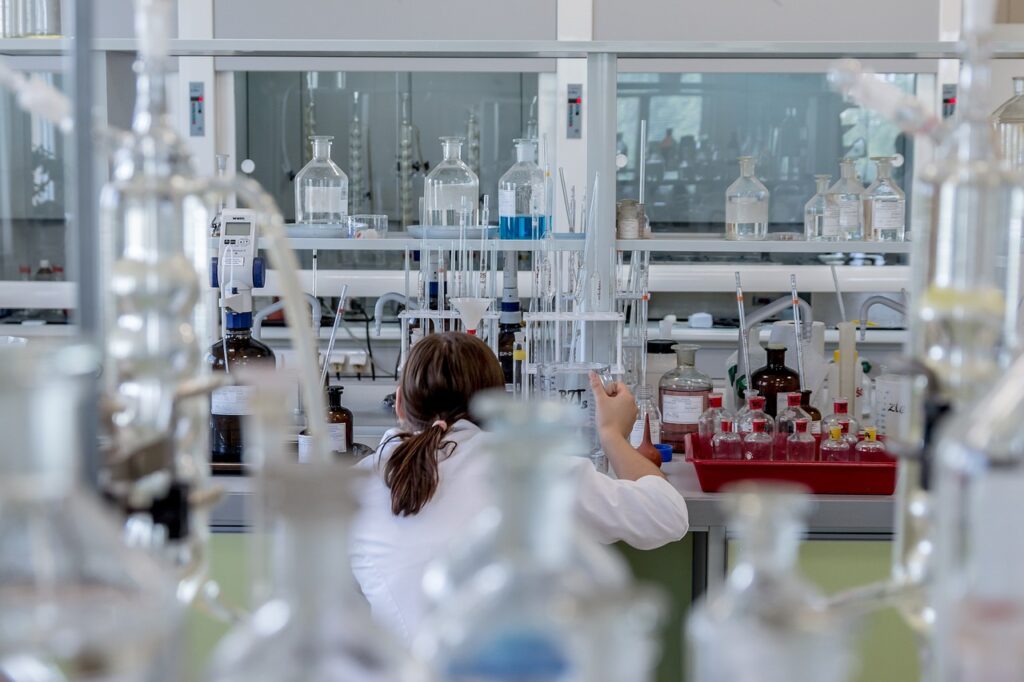
Chemistry laboratories play a vital role in scientific research, industrial development, and the quality control of chemical products. Whether analyzing raw materials, developing new formulations, or ensuring product compliance with regulations, these laboratories are indispensable in many sectors. Thanks to specialized equipment and advanced methodologies, they enable the precise identification, quantification, and characterization of chemical substances.
YesWeLab facilitates this access to laboratory analyses by offering a digital platform allowing manufacturers to centralize their requests, optimize sample management and guarantee results that comply with current standards.
Table of Contents
What is a chemistry laboratory?
Definition and missions of a chemical laboratory
A chemistry laboratory experiments, chemical analyses, and compound syntheses are carried out . It may be used for basic research, industrial development, quality control, or environmental monitoring.
The main tasks of a chemistry laboratory include:
- Analysis and identification of chemical substances : determination of the chemical composition of materials, identification of impurities and quantification of the elements present.
- The development of new molecules and formulations : creation of new chemical products, optimization of manufacturing processes and improvement of material performance.
- Quality control : validation of raw materials and finished products to ensure their compliance with regulatory and industrial standards.
- Environmental monitoring : measuring pollution levels, detecting contaminants in water, air and soil.
Chemistry laboratories are therefore strategic tools for many industries, ensuring consumer safety, regulatory compliance and technological innovation .
Laboratory equipment and infrastructure
Chemistry laboratories are equipped with specialized instruments that allow for precise analyses and experiments to be carried out under safe conditions.
Basic equipment found in a chemical laboratory :
- Extraction hoods : devices that allow volatile chemicals to be handled safely.
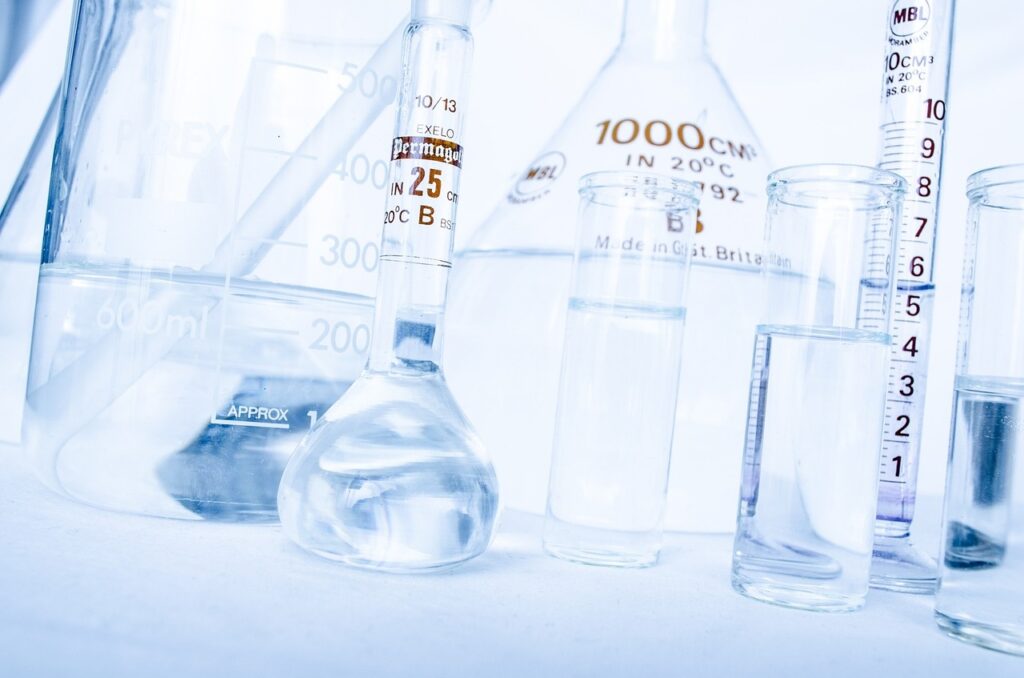
- Laboratory glassware : beakers, test tubes, pipettes, flasks and chromatography columns.
- Analytical balances : high-precision instruments used to weigh samples on the milligram or microgram scale.
- Centrifuges : devices that allow substances to be separated according to their density.
- Spectrophotometers : used to measure the absorbance of solutions and identify chemical compounds.
- Chromatographs (HPLC, GC-MS) : techniques used to separate and analyze complex mixtures.
- Elemental analyzers (ICP-MS, AAS) : allow the quantification of chemical elements present in a sample.
In addition to this standard equipment, some laboratories have specialized facilities depending on their field of activity:
- Organic chemistry laboratories : dedicated to the synthesis and characterization of carbon molecules.
- Analytical chemistry laboratories : specializing in the analysis of chemical components and impurities.
- Industrial chemistry laboratories : focused on the implementation of large-scale chemical processes.
- Environmental laboratories : focused on the analysis of pollutants and contaminants in natural environments.
Thanks to this adapted infrastructure, chemistry laboratories are able to meet the requirements of manufacturers and researchers in fields as varied as pharmaceuticals, food processing, materials and cosmetics.
Areas of application of laboratory chemistry
Chemistry is present in almost every industrial and scientific sector. Chemistry laboratories perform analyses and develop solutions tailored to the needs of each field.
Food industry
- Control of pesticides, mycotoxins and heavy metals in food products.
- Analysis of additives and preservatives to ensure their compliance with health standards.
- Detection of chemical contaminants in raw materials and finished products.
Pharmaceutical and cosmetics industry
- Development and validation of medicines and healthcare products .
- Identification and quantification of impurities and traces of heavy metals .
- Studies of the stability and compatibility of chemical formulations.
Materials and polymers
- Characterization of organic and inorganic compounds .
- Analysis of the physical and chemical properties of plastics, ceramics and metals.
- Migration tests of materials in contact with foodstuffs (compliance with EC Regulation 1935/2004 ).
Environmental chemistry
- Monitoring of pollutants in water, air and soil .
- Analysis of industrial discharges to ensure their compliance with environmental standards.
- Detection and quantification of volatile organic compounds (VOCs) and toxic heavy metals .
Chemistry laboratories are therefore essential to ensuring the safety, performance, and compliance of the products and materials used in our daily lives. They also enable us to address environmental and health challenges by implementing analytical solutions tailored to the requirements of industries and regulatory bodies.
Are you looking for an analysis?
Analytical chemistry: methods and techniques in the laboratory
Analytical chemistry is a central discipline in chemistry laboratories. It enables the detection, identification, quantification, and characterization of chemical substances present in various types of samples. Essential in many industrial sectors, it guarantees the quality of raw materials , the conformity of finished products , and consumer safety .
Definition of analytical chemistry
Analytical chemistry encompasses all the methods used to analyze the chemical composition of substances . It is divided into two main categories:
- Qualitative analysis : identification of the elements or molecules present in a sample.
- Quantitative analysis : measurement of the concentrations of the detected chemical components.
These analyses are essential in many fields, including:
- The pharmaceutical and cosmetic industries , to guarantee the absence of contaminants.
- The agri-food sector , to monitor pesticide and heavy metal residues.
- The environment , to detect chemical pollution in water, air and soil.
- Materials and polymers , to analyze the properties of plastics, ceramics and metals.
Main analytical techniques used in the laboratory
Chemistry laboratories use various advanced analytical methods to obtain reliable and accurate results.
Chromatography
Chromatography is a technique that allows the separation and analysis of the components of a mixture. It is used to identify specific molecules and measure their concentration.
- High-performance liquid chromatography (HPLC) :
- Analyzes non-volatile and temperature-sensitive substances.
- Used for the detection of drugs, food additives and chemical impurities .
- An essential technique for pharmaceutical and cosmetic quality control .
- Gas chromatography (GC-MS, GC-FID) :
- Separates and identifies volatile and semi-volatile compounds .
- Used for the analysis of hydrocarbons, solvents and organic pollutants .
- Widely used in environmental and petrochemical analyses .
Spectrometry and elemental analysis
Spectrometry techniques are essential for detecting and quantifying chemical elements at minute concentrations.
- Induced plasma mass spectrometry (ICP-MS) :
- Allows analysis of the presence of heavy metals in solid or liquid samples.
- agri-food, cosmetic and environmental analyses .
- Detection of contaminants in ultra-low trace amounts (ppt, ppb) .
- Atomic absorption spectroscopy (AAS) :
- Specific technique for analyzing metallic elements .
- Widely used for water, soil and food testing .
- X-ray fluorescence (XRF) :
- Non-destructive analysis allowing the determination of the elemental composition of solid materials .
- Used in the characterization of metallic, plastic and ceramic alloys .
Other advanced analytical techniques
- Scanning electron microscopy (SEM-EDX) :
- Allows the study of the morphology and chemical composition of solid materials.
- Useful for the analysis of industrial pollution, foreign bodies and composite materials .
- Infrared spectroscopy (FTIR, IRTF) :
- Identifies the functional groups of molecules by analyzing their interaction with infrared light.
- Key technique for the characterization of polymers and organic substances .
- Rheological tests :
- Measures the mechanical properties of materials , including their fluidity and elasticity .
- Used in the cosmetics, food and polymer .
Applications of analytical chemistry by sector
Food industry
- Detection of pesticides and mycotoxins in food.
- Control of nutritional composition and additives .
- Analysis of heavy metals and chemical residues in finished products.
Cosmetics sector
- Verification of the purity of active ingredients and excipients.
- Control of impurities and contaminants in cosmetic care.
- Stability and aging studies of chemical formulations.
Materials and polymers
- Analysis of the chemical composition of plastics and composites .
- Study of the thermal and oxidative degradation of industrial materials.
- tests of chemical substances from packaging into food.
Environmental analysis
- Monitoring of water, air and soil quality .
- Detection of hydrocarbons, solvents and heavy metals in ecosystems.
- Studies on the decontamination and remediation of contaminated industrial sites .
Analytical chemistry is therefore an essential discipline for ensuring the quality, safety, and conformity of products in many industrial sectors. Thanks to advanced analytical techniques , laboratories are able to identify even the smallest impurities and contaminants , thus contributing to the preservation of public health and the environment .
Innovations and the future of chemistry laboratories
Chemistry laboratories are constantly evolving to meet industrial, environmental, and health challenges . The integration of new analytical technologies, the digitalization of processes, and the development of more precise methods improve the efficiency of chemical analyses. These advances ensure more reliable results and facilitate the optimization of industrial processes.
New technologies in chemical analysis
The evolution of analytical instruments and detection methods allows laboratories to achieve unprecedented levels of sensitivity and precision .
Development of advanced spectrometry techniques
- High-resolution mass spectrometry (HR-MS) : allows the identification of chemical compounds with extreme molecular precision .
- ICP-MS/MS (tandem-induced plasma mass spectrometry) : improves the quantification of heavy metals and trace elements in complex matrices.
- Portable Raman and FTIR spectroscopy : allows for the analysis of chemical substances directly in the field, without prior sampling.
Integration of artificial intelligence and automation
- Predictive analysis : Artificial intelligence (AI) algorithms make it possible to anticipate potential degradation of chemical products based on storage conditions.
- Automation of analytical testing : robots and digital platforms facilitate the execution of serial analyses , thereby reducing delays and human errors.
- Big data in analytical chemistry : the exploitation of massive data makes it possible to improve the traceability of analytical results and to optimize detection methods.
These advances allow for faster, more accurate and reproducible results , while reducing the environmental impact of analyses through techniques requiring fewer reagents and producing less waste .
Digitalization of laboratory analyses
The digital transformation of laboratories makes it possible to optimize sample management, the interpretation of results and the traceability of analyses .
Online platforms for managing analyses
- Centralization of analysis requests via digital interfaces accessible in real time .
- Tracking of samples, results and analysis times on a single platform.
- Automation of analytical reports and instant generation of compliance certificates .
YesWeLab optimizes chemical analyses
YesWeLab is a key player in the world of laboratory chemical analysis , offering manufacturers an optimized solution to centralize and manage their analytical needs . Thanks to a network of over 200 accredited partner laboratories , the YesWeLab platform provides easy access to high-quality analytical services that comply with regulatory requirements .
A network of specialized laboratories for customized analyses
YesWeLab's partner laboratories are selected for their expertise, accreditation, and ability to provide reliable and rapid analyses .
Expertise in various industrial sectors
YesWeLab supports companies in several industries:
- Agri-food : analyses of chemical contaminants, heavy metals, pesticide residues and food additives .
- Cosmetics : control of active ingredients, impurities and stability of formulations .
- Materials and polymers : characterization of the chemical, thermal and mechanical properties of materials .
- Environment and safety : detection of pollutants in air, water and soil .
By choosing YesWeLab, companies benefit from rapid access to specialized laboratories capable of meeting the most complex analytical challenges.
A digital platform to centralize chemical analyses
YesWeLab offers an intuitive and efficient interface that allows manufacturers to simplify the management of their laboratory analyses .
Optimization of the analysis process
Thanks to the YesWeLab digital platform, companies can:
- Order and track their analyses in real time without intermediaries.
- Manage their samples centrally , with complete traceability.
- Quickly access results and analysis reports online.
- Compare and select the most suitable laboratories based on analytical needs.
Advantages for manufacturers
- Reduction of analytical delays thanks to an optimized management system.
- Data security and instant access to certified results.
- Regulatory compliance is ensured with monitoring of the standards applicable to each analysis.
The digitalization of analyses saves time, optimizes costs and guarantees complete traceability of samples and results .